 Promenaut
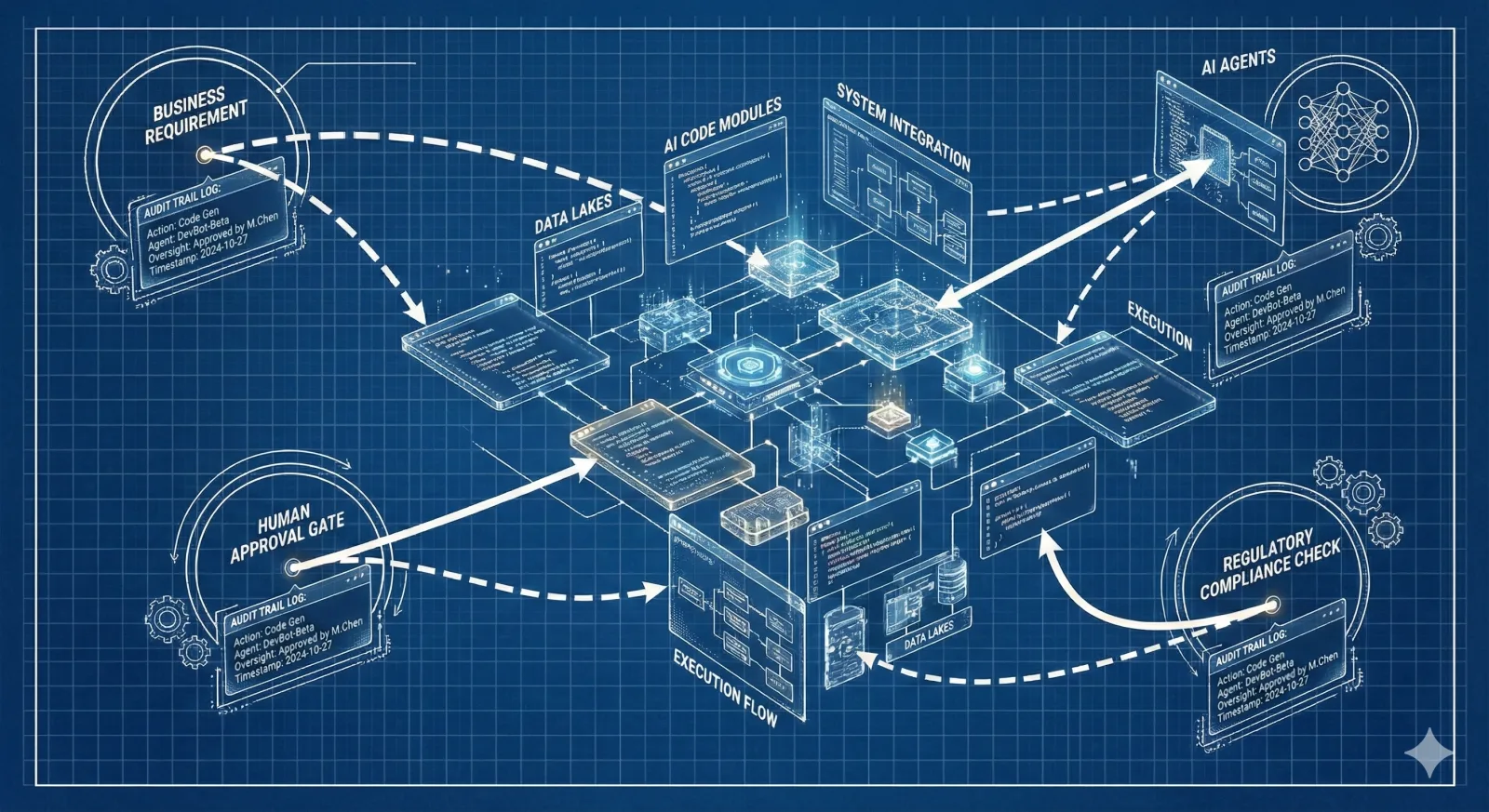
Software development has always been complex. AI makes it exponentially more so.
When a human writes code, you know who did it, when they did it, and (hopefully) why they did it. Version control, code reviews, and documentation create a trail you can follow.
When AI agents write code, generate requirements, suggest architecture, or make decisions, who's accountable? What was the reasoning? Can you prove compliance? Can you even reconstruct what happened?
Without traceability, AI development is a black box. And black boxes don't pass audits.
The Traceability Gap in AI Development
Organizations are enthusiastically adopting AI development tools. They're seeing real productivity gains - faster feature delivery, reduced routine work, accelerated development cycles.
Then compliance asks a simple question: "Can you show me how this feature was developed and who approved each decision?"
Silence.
The productivity gains disappear behind a compliance wall. The pilot that seemed so promising can't move to production. The AI tools that work great for personal projects create enterprise liability.
What's Missing: End-to-End Traceability
Enterprise software development isn't just about writing code. It's about proving what happened and why.
Who decided what. Which stakeholder defined the requirement? Who approved the technical approach? Which architect validated the design? Who signed off on the implementation?
Why decisions were made. What business need drove this feature? Why was this architecture chosen over alternatives? What risk assessment informed the approach? How were compliance requirements addressed?
When things changed. What was modified and when? Who authorized the change? What was the impact analysis? Were dependent systems notified?
How quality was ensured. What validation occurred at each stage? Which quality gates were passed? What testing confirmed correctness? How was security verified?
Traditional development has processes (however imperfect) to answer these questions. AI development often has... hope.
Why Traceability Matters Even More with AI
Regulatory Compliance
Regulated industries don't just need software that works. They need provable, auditable development processes.
Financial services organizations must prove their trading algorithms were developed according to documented standards and approved by appropriate authorities. Healthcare companies must demonstrate that patient data processing logic was validated for HIPAA compliance at each stage. Government agencies must show that systems meet accessibility requirements and that compliance was verified throughout development.
Without traceability, the answer is "probably" or "we think so." That's not good enough.
Debugging and Maintenance
Six months after an AI agent generated a feature, a bug emerges. What was the original requirement? What decisions led to this implementation? What alternatives were considered? What assumptions were made?
Without traceability, you're reverse-engineering your own system. With it, you understand context immediately and can fix issues confidently.
Knowledge Preservation
Developers leave. Contractors rotate. Institutional knowledge evaporates.
With traceability, new team members understand why things are the way they are. Historical context is preserved automatically. Decisions don't need to be relitigated. Technical debt has documented rationale.
Accountability and Trust
When AI agents are involved in development, accountability becomes murky. "The AI did it" isn't a defense when something goes wrong.
Traceability provides a clear record of AI suggestions and human approvals. It documents decision points with responsible parties. It creates an audit trail proving oversight occurred. It builds confidence that processes were followed and that humans remained in control.
What Enterprise-Grade Traceability Actually Looks Like
Traceability isn't just version control. It's a complete record of the development journey from initial requirement through production deployment and ongoing maintenance.
From Requirement to Production
Complete traceability means you can trace every feature from business need through implementation. You know who submitted the requirement and what business need it addresses. You can see what AI analysis occurred and why specific approaches were chosen. You understand what code was generated versus human-written and which quality checks were applied. You have records of what tests were executed and who signed off on production readiness.
Every step documented. Every decision captured. Every approval recorded. Not as an afterthought, but automatically as development progresses.
Beyond Initial Development
Traceability doesn't end at deployment. It's essential for ongoing application management.
For change management, you need to track every modification to deployed applications and understand the cumulative impact of changes. When incidents occur, you need to quickly trace back to understand what changed and when. For application lifecycle management, you need to understand total cost of ownership and make informed modernization decisions based on historical data.
This historical context becomes increasingly valuable over time. The traceability from two years ago helps you understand systems better than documentation ever could.
Supervised AI with Built-In Traceability
This is why we built traceability into the core of Promenaut's platform. We believe AI development should be both fast and governable. Supervised AI means humans remain in control while agents execute work - and every step leaves a trace.
See It in Action: PRD Squad Demo
We recently released a demo showing how enterprise-grade traceability works in practice with our PRD Squad - a specialized collection of AI agents that handles product requirement documents from initial submission through completion.
The workflow demonstrates traceability at every stage:
Requirement submission. The product manager submits a PRD. The system automatically captures who submitted it, when, and the business context. The assignment to the PRD Squad is logged with a timestamp.
AI analysis with oversight. The PRD Squad analyzes the requirements, identifying gaps, ambiguities, and risks. Every analysis step is documented automatically. A human review checkpoint records who reviewed the analysis, when they did it, and what decision they made. No manual documentation required.
Technical specification generation. Agents generate detailed technical specs while the platform checks them against organizational standards. The system suggests improvements based on past projects. Both the AI recommendations and human approvals are captured automatically. Quality checks run with results documented for future reference.
Coherence validation. The platform cross-references with related requirements, checks for conflicts with existing architecture, and validates completeness. All validation results and decision rationale are recorded, creating a clear picture of why the requirement is ready to proceed.
Approval and handoff. At the final human approval gate, a complete audit trail is generated automatically. The requirements package moves to development with full provenance from submission to approval. No manual compilation of documentation needed.
Throughout the entire workflow, every agent action is documented with context about what was done, why, and when. Human checkpoints are recorded showing who approved what they reviewed and their decision. Quality metrics are captured showing which checks ran and their results. Cost tracking shows which agents were used and compute costs incurred. Timeline visibility reveals how long each stage took and where delays occurred.
The result is complete traceability from PRD submission to approved requirements, with every decision, validation, and approval documented automatically as a byproduct of the development process.
The Business Impact of Traceability
Traceability transforms from compliance burden to competitive advantage.
Most organizations view traceability as a necessary evil - something required to pass audits but that slows everything down. This perspective misses the strategic value. When traceability is built into your development platform rather than bolted on afterward, it becomes an accelerator rather than a brake.
Consider what happens when a critical production issue emerges. Without traceability, your team spends hours or days reconstructing what happened. They interview developers who may no longer be with the company. They dig through git logs and hope someone remembers the context. They make educated guesses about why certain decisions were made. This investigation delays the fix and increases the risk of making it worse.
With enterprise-grade traceability, the investigation takes minutes. You see exactly when the code was deployed, who approved it, what requirements it addressed, what tests validated it, and what changed from the previous version. You understand the decision context immediately. You fix the issue with confidence. The mean time to resolution drops dramatically.
This pattern repeats across your organization. Audits that used to take weeks of preparation become straightforward. New developers who used to take months to understand systems are productive in weeks. Technical decisions that used to require lengthy meetings to reconstruct context happen faster because the context is already documented. Risk assessments for changes become data-driven rather than gut-feel.
The ROI isn't just in avoided compliance penalties or reduced audit costs, though those are real. The bigger value is in organizational velocity. When everyone has instant access to development history and decision context, the entire organization moves faster. Knowledge workers spend less time searching for information and more time acting on it.
Traceability also enables a different kind of strategic decision-making. With complete development history, you can answer questions that were previously unanswerable: Which architectural patterns deliver the best outcomes? Which types of AI recommendations do our engineers accept or reject, and why? Where do our quality issues actually come from? What's the true cost of maintaining different parts of our application portfolio?
These insights compound over time. The organization learns not just from recent projects but from years of development history. Patterns emerge that would be invisible without comprehensive traceability. Best practices become evidence-based rather than opinion-based.
What Traceability Requires from Your Platform
You can't retrofit traceability. It must be built into the platform from the start.
Automated Capture at Every Step
Manual documentation doesn't scale and isn't reliable. The platform must automatically record every agent action and recommendation, human review and approval decision, quality check and result, change and its context, and cost and resource usage. This happens as a byproduct of development work, requiring no extra effort from developers.
Structured, Queryable Information
Raw logs aren't traceability. You need structured metadata that captures who (which human, agent, or system), what (action taken, decision made, change applied), when (timestamp, duration, sequence), why (business context, technical rationale), and how (process followed, standards applied). This enables powerful querying like "show me all architecture decisions approved by John in Q3 affecting the payments module."
Immutable and Trustworthy Records
Traceability you can modify after the fact isn't traceability. The platform must ensure records can't be altered after creation, provide tamper-proof logging, offer cryptographic verification when needed, and enable long-term retention for compliance. Regulators need to trust the record completely.
Accessible to Non-Technical Stakeholders
Compliance officers and auditors aren't developers. The platform must provide natural language summaries of technical decisions, visual workflow representations, plain-English explanations of agent actions, and accessible reports for non-technical stakeholders. "The AI did X" needs to be understandable by everyone involved in oversight.
Seamless Integration with Development
Traceability can't be a separate system that developers update manually. It must integrate with version control, CI/CD, and deployment tools. It needs to connect requirements to code to deployment automatically. Changes must link back to business needs without developer intervention. The experience should be seamless, and traceability happens as a natural byproduct of development work.
Traceability: The Foundation for AI at Scale
The real question isn't whether to adopt AI development tools. It's whether you can govern them at scale.
Right now, most organizations are in the experimentation phase. A few dozen AI agents. Manual oversight. Manageable complexity. But this doesn't represent the future state.
Five years from now, successful enterprises will have thousands of AI agents working across every stage of the software development lifecycle. Requirements analysis, architecture design, code generation, testing, deployment, monitoring - all augmented or automated by AI. The productivity gains will be transformative. The organizations that figure this out will move 10x faster than those that don't.
But here's what nobody talks about: scaling from 10 agents to 10,000 agents isn't a technology problem. It's a governance problem.
You can't manually review every action from 10,000 agents. You can't have approval meetings for every decision. You can't rely on tribal knowledge to understand what's happening. Traditional oversight mechanisms break down completely at this scale.
This is where traceability becomes existential rather than nice-to-have. Without comprehensive, automated traceability, you're forced to choose between speed and control. Move fast with thousands of agents and lose visibility into what they're doing, or maintain control through manual oversight and sacrifice all the productivity gains.
Enterprise-grade traceability breaks this trade-off. It enables a risk-based governance model that scales: low-risk agent actions proceed automatically with monitoring, high-risk decisions trigger human approval gates, edge cases escalate to experts, and the system learns over time which patterns are safe versus risky.
The traceability infrastructure makes this possible. Every agent action is categorized by risk level based on what it's doing, what systems it's touching, and what data it's accessing. The platform automatically routes high-risk actions for human review while letting low-risk work proceed. All of it is logged, creating an organizational memory that continuously improves.
The organizations building this traceability infrastructure now, while they still have 10 agents, will be ready to scale to 10,000. The ones waiting until they have a governance crisis will be scrambling to retrofit traceability while competitors pull ahead.
There's a window of opportunity here. AI development tools are still immature enough that building proper governance foundations is feasible. Wait a few years, and you'll have accumulated AI-generated code that you can't fully explain, decisions you can't fully defend, and technical debt you can't fully understand. That's when traceability shifts from strategic advantage to existential requirement.
The question isn't whether comprehensive traceability will become mandatory for enterprise AI development. The question is whether you'll build it proactively as a competitive advantage, or reactively as a compliance necessity.
Learn More About Promenaut
We built Promenaut with traceability at its core because we believe enterprises need AI development that's both fast and governable. Supervised AI with complete traceability. From requirement through production. For compliance, for maintenance, for confidence.
Want to discuss traceability requirements for your organization? Contact us directly at hello@promenaut.ai - we'd love to hear about your challenges.
Entrepreneur, technologist and founder. My background combines deep technical roots with real-world operational leadership. I’ve held senior and C-level roles at Goldman Sachs, Merrill Lynch, HSBC, and BTG Pactual, and operated across the world’s key financial centers -New York, São Paulo, Hong Kong, and London. Now focused on advising, investing in, and launching new ventures - particularly where AI, developer productivity, and financial innovation intersect. I bring a builder’s mindset, proven execution across multiple markets, and a strong global network of investors, founders, and enterprise leaders.