 Promenaut
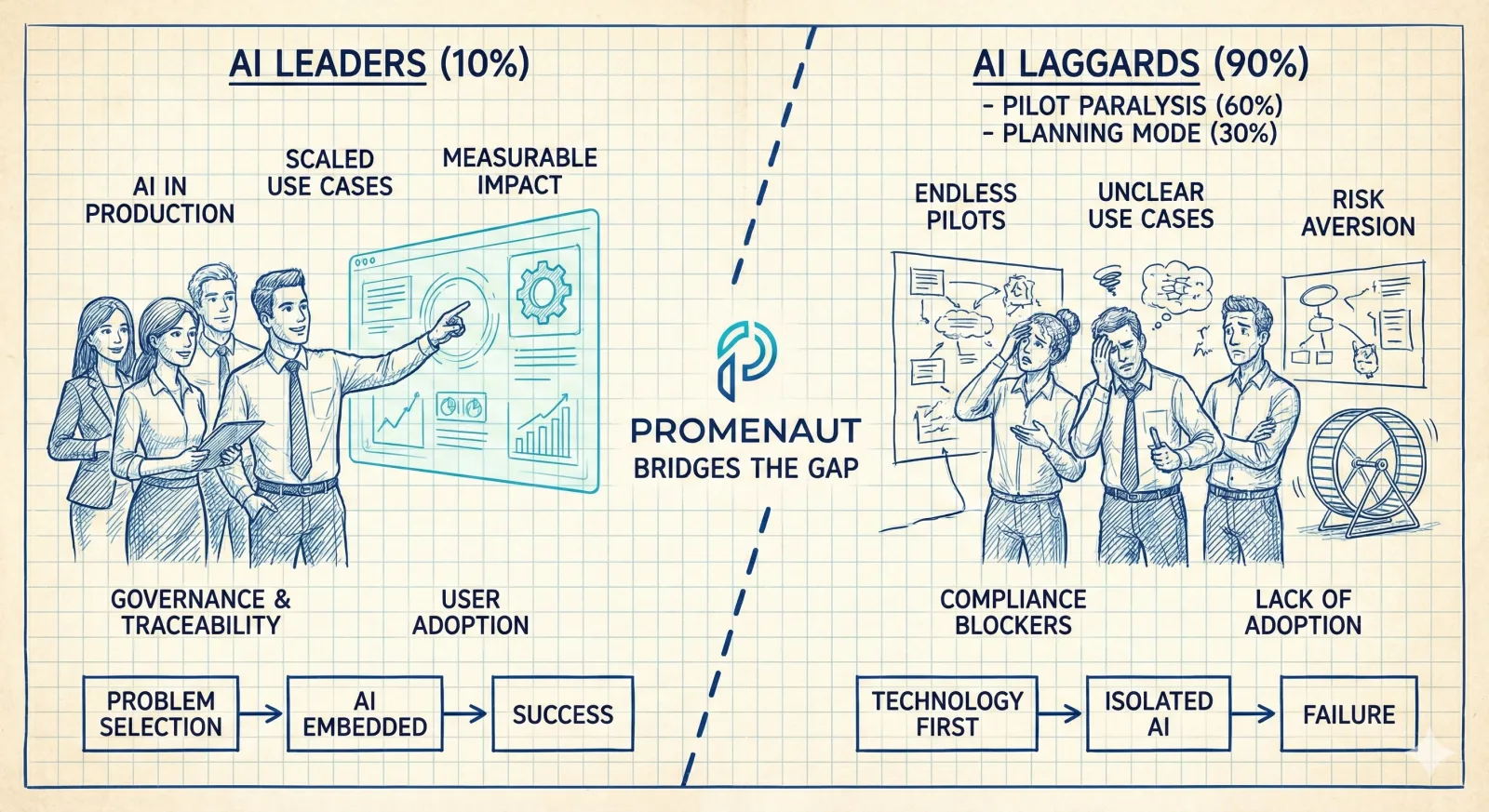
The enterprise AI narrative has become predictable: every company claims to be "AI-first," every vendor promises revolutionary transformation, and every conference panel declares we're at an inflection point. But beneath the noise, something more interesting is happening. A quiet bifurcation is emerging between organizations making genuine progress and those still trapped in pilot purgatory.
After conversations with dozens of enterprise leaders over the past year, a pattern has crystallized: the gap between AI leaders and laggards isn't about technology, budgets, or even talent. It's about something more fundamental - and more fixable.
The Real State of Play
Fewer than 10%: A small cohort has moved beyond experimentation. They're running AI in production, seeing measurable business impact, and scaling successful use cases across the organization. Their AI initiatives have executive sponsorship, dedicated budgets, and clear ROI metrics.
The vast middle: Enterprises stuck in what we call "pilot paralysis." They've run proof-of-concepts, built impressive demos, and generated enthusiastic slide decks. But few of these initiatives have made it to production. They're caught in an endless cycle of experimentation without implementation.
The laggards: A surprising segment hasn't moved beyond vendor pitches and exploratory conversations. They know they "should" be doing something with AI, but organizational inertia, unclear use cases, or risk aversion keeps them perpetually in planning mode.
So - despite exponential improvements in AI capabilities over the past two years - what is holding enterprises back? The bottleneck isn't the technology - it's organizational readiness.
What Actually Separates Progress from Hype
After examining the patterns across leaders and laggards, four clear differentiators emerge:
1. Problem Selection: Starting with Pain, Not Possibility
The organizations making real progress didn't start by asking "What can AI do for us?" They started with "What's costing us time, money, or customers - and could AI solve it?"
What works:
- A financial services firm automated contract review because legal bottlenecks were delaying deals by weeks
- A healthcare provider deployed AI triage because ER wait times were driving patient dissatisfaction
- A logistics company used AI for route optimization because fuel costs were eating margins
What doesn't:
- "Let's use AI to innovate"
- "We need an AI strategy"
- "Everyone else is doing AI, so should we"
The difference is specificity. Leaders start with a concrete problem that has measurable business impact. Laggards start with technology looking for a problem.
2. Organizational Design: Embedding AI, Not Siloing It
The failed pattern is depressingly common: create a "Center of Excellence," hire a Chief AI Officer, run some pilots, declare victory. The result? AI remains isolated from the business, dependent on a small team that becomes a bottleneck, and ultimately fails to scale.
The successful pattern looks different. Leaders are embedding AI capabilities directly into business units:
- Marketing teams have their own AI tools for content and campaign optimization
- Sales teams use AI-powered insights in their daily workflow
- Operations teams deploy AI where it creates immediate efficiency gains
This doesn't mean eliminating central AI teams - it means their role shifts from doing AI projects to enabling the business to do AI themselves. They become platforms, not project teams.
3. User Experience: Building AI That People Actually Want to Use
Here's the paradox: while the majority of knowledge workers now use AI tools in their personal lives, reporting significant productivity gains. Yet these same users - the ones who integrate ChatGPT into their daily routines - describe their company's enterprise AI tools as unreliable, frustrating, and inferior.
This creates a fundamental challenge: the more employees experience good AI, the less tolerant they become of bad enterprise AI.
The root cause isn't the underlying models. It's that enterprise AI tools lack the adaptive, contextual capabilities users now expect as baseline. Consumer AI learns from interactions, remembers context, and improves over time. Enterprise tools, built primarily for compliance and control, often sacrifice these capabilities entirely. The result is a static system that feels like a downgrade from free consumer tools.
Why enterprise AI fails the adoption test:
Lack of context and memory
Consumer AI remembers your preferences, past conversations, and working style. Enterprise AI treats every interaction as if it's the first, forcing users to re-explain context repeatedly. When a tool can't remember what you told it yesterday, adoption craters.
Model quality without customization
Generic models trained on public data produce generic outputs. Without the ability to learn from company-specific data, terminology, and workflows, enterprise AI gives answers that are technically correct but practically useless. Users quickly learn the system doesn't understand their actual work.
Poor integration with existing workflows
The best enterprise AI should be invisible - embedded in tools people already use. Instead, most implementations require context switching to separate platforms, manual data entry, and workflow disruptions. Each friction point is another reason to abandon the tool.
This isn't about being risk-averse or prioritizing security over usability. It's about recognizing that adoption is a prerequisite for value. If employees won't use the tool, its governance and security features are irrelevant. The organizations succeeding at scale have built AI systems that match the quality users experience in consumer tools while meeting enterprise requirements.
4. Governance & Traceability: The Missing Foundation
Finally, why most AI initiatives never make it to production: enterprises can't deploy what they can't govern, audit, or explain.
When AI works perfectly in a demo but fails to ship, the problem usually isn't the model - it's that no one can answer basic enterprise requirements:
- Which version of the model produced this output?
- What data was used to generate this decision?
- How do we roll back if something goes wrong?
- Who approved this change to the AI system?
- Can we demonstrate compliance to auditors?
Traditional AI tools treat governance as an afterthought - something to bolt on later, if at all. The result? Legal blocks deployment. Compliance raises red flags. Risk management says no. The pilot dies in committee, and the team goes back to building another demo.
The organizations actually shipping AI to production have solved governance first. They've built systems with:
- Complete traceability of every AI decision back to the specific model version, input data, and configuration
- Audit trails that satisfy compliance requirements before deployment, not after
- Version control that treats AI systems with the same rigor as financial systems
- Rollback capabilities that let teams move fast without breaking things permanently
This isn't about being risk-averse or bureaucratic. It's about being able to deploy AI at enterprise scale with confidence.
The companies stuck in pilot mode aren't being too cautious - they're using tools that can't meet basic enterprise requirements.
The Uncomfortable Questions No One's Asking
The gap between AI rhetoric and reality exposes some uncomfortable truths about enterprise transformation:
Are we solving real problems or checking boxes?
Many AI initiatives exist because someone read that "AI is the future" and decided the company needs to be doing it. The absence of a clear business case doesn't stop the project - it just dooms it to irrelevance.
Are we building capabilities or dependencies?
Outsourcing everything to vendors or consultants creates short-term progress but long-term fragility. The organizations pulling ahead are building internal capabilities, even if it's slower at first.
Are we actually changing how we work?
AI requires different workflows, different decision-making processes, and different organizational structures. Companies that try to bolt AI onto existing processes get marginal improvements at best. Real transformation requires rethinking how work gets done.
Can employees actually use this?
Most AI tools are built for compliance teams and IT departments, not end users. If your AI solution doesn't match the experience of consumer tools employees already love, you're fighting an uphill battle for adoption - one you'll likely lose.
Can we actually govern this at scale?
Most AI tools are built for experimentation, not enterprise deployment.
If your AI solution can't answer "what changed, when, and why" for every output, you're not ready for production - no matter how good the demo looks.
What "Good" Actually Looks Like
The leaders we've observed share a few common characteristics:
They have executive sponsors who understand AI limitations
Not cheerleaders who think AI solves everything, but pragmatists who understand what it can and can't do. They provide air cover for reasonable failure and push back on unrealistic expectations.
They measure business outcomes, not AI metrics
Model accuracy matters less than customer satisfaction, cost reduction, or revenue growth. If the AI improves the business metric, it's working - even if it's not technically perfect.
They've solved the data problem first
Before worrying about models, they invested in data infrastructure, governance, and quality. Boring? Yes. Essential? Absolutely.
They build for actual users, not just compliance committees
Every successful deployment starts with understanding what users need and what they'll actually adopt. Compliance and governance get built in from the start - but they're designed to enable good UX, not prevent it.
They can demonstrate compliance and traceability
Every AI system in production has complete audit trails, version control, and governance documentation. This isn't a nice-to-have - it's table stakes for enterprise deployment.
They plan for change management from day one
They know the technology is the easy part. Getting people to change how they work is the hard part, so they invest in training, communication, and incentives accordingly.
The Path Forward
If you're in the majority middle stuck in pilot mode or have yet to go beyond planning, here's advice to heed: your next AI pilot won't succeed if it can't meet two fundamental requirements.
First, it must deliver an experience users will actually prefer to their current workflow - and to the consumer AI tools they already use. If your enterprise AI feels like a downgrade from ChatGPT, you're building expensive demos that will never escape the pilot phase.
Second, it must meet basic enterprise governance requirements. Before you start another proof-of-concept, ask whether your tools can demonstrate compliance, explain decisions, and roll back changes. If not, you're not building enterprise AI - you're building prototypes that will die in committee.
Pick one use case with clear business value, ensure you have both the user experience and governance foundation to deploy it safely, assign a cross-functional team, and get it into production.
The gap between AI leaders and everyone else isn't widening because leaders are more risk-tolerant or have better technology. It's widening because they've built systems that users actually want to adopt AND that enterprises can actually govern at scale.
How Promenaut Bridges Both Gaps
At Promenaut, we built our platform around a fundamental insight: enterprises don't need more impressive demos. They need AI systems that users will actually adopt AND that enterprises can safely deploy and govern.
Adaptive AI that learns and remembers
Promenaut's AI adapts to your organization's context, terminology, and workflows. It remembers past interactions and improves over time, delivering the personalized experience users expect from consumer tools - while maintaining full enterprise control and auditability.
Context-aware outputs that actually work
By integrating directly with your systems and data, Promenaut delivers answers grounded in your company's specific context. No more generic responses that miss the nuances of your business - the AI understands your domain because it learns from your operations.
Built-in traceability from day one
Every AI decision in Promenaut includes complete provenance - which model version, what input data, what configuration, who approved it. Not bolted on as an afterthought, but architected into the core platform. When auditors or compliance teams ask questions, you have answers.
Enterprise-grade version control
We treat AI systems with the same rigor enterprises apply to financial systems. Every change is tracked, every deployment is logged, and every configuration is versioned. Roll back to any previous state instantly if something goes wrong.
Seamless workflow integration
Promenaut integrates into the tools your teams already use. No separate platforms, no context switching, no workflow disruption. AI becomes a natural extension of existing work rather than a separate system to manage - and stays compliant with existing governance frameworks.
Governance that enables speed, not bureaucracy
Our approach isn't about adding more approval layers - it's about building systems that are safe to deploy quickly. When you have complete traceability, rollback capabilities, and user adoption, you can move fast without breaking things.
The result? Organizations using Promenaut see adoption rates that match consumer AI tools because employees actually prefer using it - while IT and compliance teams get the control and visibility they need to deploy with confidence.
The technology is ready. The governance foundation exists.
The question is: are you building AI that users will actually adopt AND that enterprises can actually govern?
Ready to move beyond pilots? Promenaut works with enterprise leaders who understand that adoption and governance are both prerequisites for value. Get in touch to see how we deliver enterprise-grade AI with consumer-grade experience.
Entrepreneur, technologist and founder. My background combines deep technical roots with real-world operational leadership. I’ve held senior and C-level roles at Goldman Sachs, Merrill Lynch, HSBC, and BTG Pactual, and operated across the world’s key financial centers -New York, São Paulo, Hong Kong, and London. Now focused on advising, investing in, and launching new ventures - particularly where AI, developer productivity, and financial innovation intersect. I bring a builder’s mindset, proven execution across multiple markets, and a strong global network of investors, founders, and enterprise leaders.