 Promenaut
Intro: The workforce transformation already underway
Most conversations about AI and work start in the wrong place.
They focus on job loss instead of work redesign.
They ask “Will AI replace people?” instead of “What work should humans no longer be doing?”
Inside enterprises, a quieter but far more powerful shift is underway:
AI isn’t replacing workers - it’s becoming a digital workforce.
Not as a single tool.
Not as a chatbot.
But as a coordinated set of digital roles that assume responsibility for execution - under human governance, architectural constraints, and enterprise controls.
This isn’t about replacement.
It’s about responsibility.
Deciding which work should be executed digitally - and which must remain human - is quickly becoming the defining leadership challenge of the AI era.
From tools → agents → workforces
Enterprise AI has evolved through three distinct phases:
Phase 1: Tools
AI as assistance - autocomplete, summarization, chat.
Phase 2: Agents
AI that performs tasks - writing code, generating tests, drafting workflows.
Phase 3: Workforces
AI that performs roles, collaborates with other agents, operates under governance, and integrates into enterprise operating models.
Most organizations are still operating between phases one and two.
The real transformation begins in phase three.
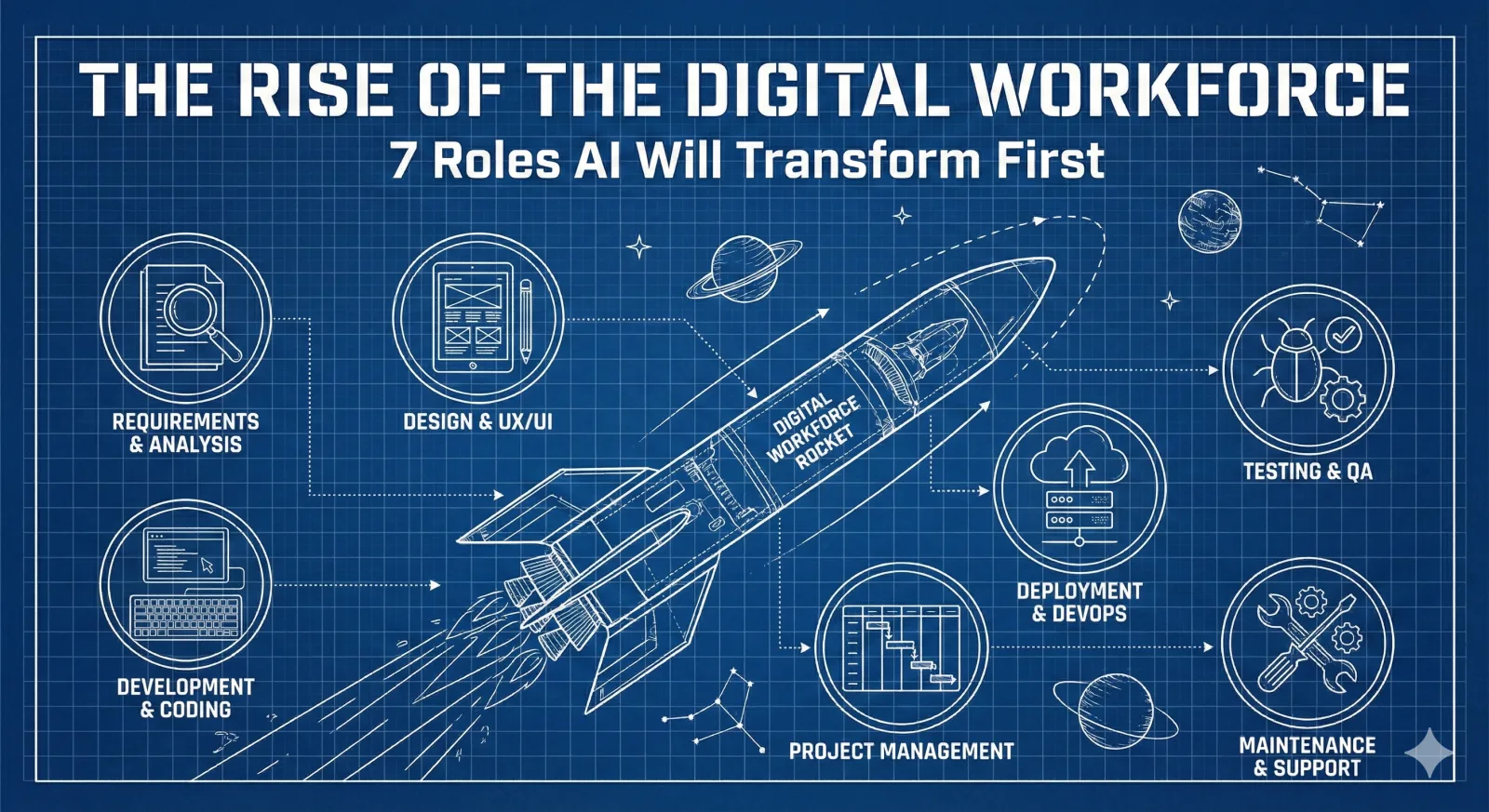
The 7 roles AI will transform first
These roles share three characteristics:
- highly repetitive
- structurally defined
- execution-heavy
They are ideal candidates for digital ownership.
1. Software Implementation (Execution Layer)
This does not mean developers disappear.
It means execution work becomes digital.
AI excels at:
- translating specifications into code
- applying known patterns
- refactoring
- generating and maintaining tests
- evolving components safely
Human developers shift toward:
- architecture decisions
- system ownership
- design constraints
- quality oversight
Execution becomes digital.
Ownership remains human.
2. QA & Regression Testing
Manual testing is one of the most fragile points in software delivery.
AI can:
- generate comprehensive test suites
- maintain regression coverage automatically
- simulate edge cases
- run tests continuously
Humans focus on:
- test strategy
- acceptance criteria
- exception analysis
Testing becomes continuous - not optional.
3. Documentation & Knowledge Management
Every enterprise suffers from the same problem:
The documentation is always wrong.
AI solves this by:
- updating documentation as systems change
- maintaining architecture diagrams
- synchronizing requirements with reality
- keeping runbooks current
This is one of the highest-ROI digital roles - and one of the least controversial.
4. Business Analysis & Requirements Translation
AI is exceptionally good at:
- asking clarifying questions
- identifying gaps
- mapping processes
- translating intent into structured logic
Business-facing AI agents allow:
- product owners to iterate faster
- SMEs to work directly with systems
- fewer handoffs
- less misinterpretation
This is where non-developers meaningfully enter the SDLC.
5. Release & Deployment Coordination
Release management is repetitive, procedural, and risk-sensitive — ideal for AI.
AI can:
- manage release checklists
- validate readiness
- enforce approvals
- coordinate rollouts
- track dependencies
Humans intervene only when judgment is required.
6. Compliance & Control Execution
Compliance work requires consistency, not creativity.
AI excels at:
- enforcing policy adherence
- collecting audit evidence
- validating data flows
- ensuring segregation of duties
In regulated markets, this role alone unlocks enterprise AI adoption at scale.
7. Legacy Migration Execution
One of the most powerful digital workforce roles.
AI can:
- analyze legacy systems
- map dependencies
- rewrite components incrementally
- maintain regression safety
- document transformations
Humans define the target architecture.
AI executes the migration.
What humans keep: the work that actually matters
As digital roles take on execution, human roles evolve upward.
Humans remain responsible for:
- decision-making
- architectural design
- constraint definition
- ethical oversight
- exception handling
- accountability
In the digital workforce era, humans don’t compete with AI - they design, govern, and lead it.
Why enterprises must think in roles, not jobs
Enterprises don’t reorganize around tools.
They reorganize around roles and responsibilities.
That’s why “AI assistants” fail as an operating model.
Assistants don’t fit org charts.
Roles do.
Digital workforces integrate cleanly into:
- governance models
- approval chains
- risk frameworks
- operating structures
This is how AI becomes enterprise-grade.
The competitive gap is about to widen dramatically
Two enterprises start with similar teams.
One deploys:
- digital testers
- digital BAs
- digital migration squads
- digital release managers
The other debates tooling.
Within a year:
- delivery speed diverges
- backlog size diverges
- modernization progress diverges
- cost structures diverge
This advantage compounds.
Closing: The future workforce is human and AI - by design
The most important transformation underway in enterprises is not cloud or SaaS.
It’s the emergence of the digital workforce.
The winners won’t be the companies with the best tools.
They’ll be the ones who redesign work itself.
And it starts with a simple shift:
Stop asking what AI can help with.
Start deciding which roles AI should own.
Entrepreneur, technologist and founder. My background combines deep technical roots with real-world operational leadership. I’ve held senior and C-level roles at Goldman Sachs, Merrill Lynch, HSBC, and BTG Pactual, and operated across the world’s key financial centers -New York, São Paulo, Hong Kong, and London. Now focused on advising, investing in, and launching new ventures - particularly where AI, developer productivity, and financial innovation intersect. I bring a builder’s mindset, proven execution across multiple markets, and a strong global network of investors, founders, and enterprise leaders.