 Promenaut
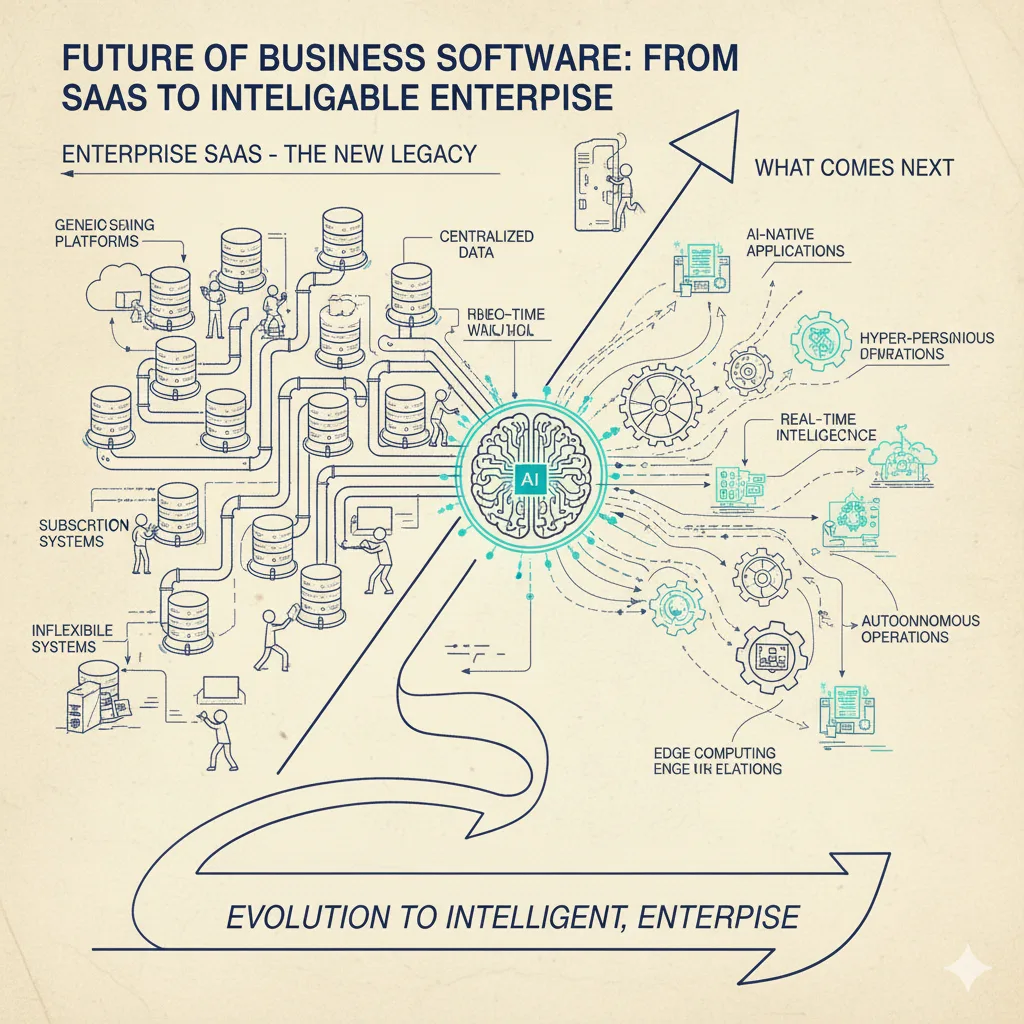
Intro: The inconvenient truth about SaaS
Ten years ago, buying SaaS was the modern thing to do.
Faster onboarding. Less maintenance. No deployment overhead.
It felt like a cheat code.
But here’s the uncomfortable reality most enterprises won’t say out loud:
Enterprise SaaS has quietly become the new legacy.
It’s slow to change.
It’s resistant to customization.
It locks you into someone else’s roadmap.
And in many cases, the “best-in-class SaaS solution” is now the single biggest blocker to modernization.
The irony?
The software you bought to escape legacy… became legacy.
Let’s break down why.
1. SaaS solved yesterday’s problem — not today’s
SaaS was built for a world where the priority was:
- reduce IT headcount
- shrink on-premise footprint
- outsource upgrades
- standardize processes
That world is gone.
Today, enterprises need:
- hyper-specific workflows
- deep integration into proprietary systems
- real-time data orchestration across dozens of platforms
- AI-enabled processes that evolve weekly
- architecture alignment with internal target-state blueprints
SaaS cannot keep up with this level of customization, complexity, and velocity.
It was designed for stability, not evolution.
Now stability is the bottleneck.
2. SaaS forces you to standardize around its opinion of your business
Every SaaS product has a worldview baked into it.
- A specific data model
- A specific workflow
- A specific permission model
- A specific integration philosophy
- A specific way components should talk to each other
This is fine — until it isn’t.
Because eventually, your business changes.
And when you try to extend SaaS beyond its original intent, you hit a wall:
“We can’t do that.”
“That’s not supported.”
“We can put it on the roadmap.”
“You’ll need to wait until Q4 next year.”
“We could maybe support that with a new enterprise tier.”
Your business evolves.
Your SaaS vendor’s worldview does not.
This is how “SaaS lock-in” sneaks up on organizations.
3. The hidden cost: integration entropy
Every SaaS tool you buy needs to integrate with:
- core systems
- shadow systems
- bespoke processes
- multiple SaaS tools your teams already bought
What happens then?
A flood of:
- brittle APIs
- third-party connectors
- fragile workflows
- accidental data silos
- inconsistent states
- reconciliation pipelines
- surprise operational overhead
Each new SaaS tool adds integration cost, not integration leverage.
When you zoom out, many enterprises discover a harsh truth:
Their SaaS portfolio is a tangled, fragile, slow-moving ecosystem glued together by duct tape integrations.
This is not modernization — it’s fragmentation.
4. SaaS freezes your architecture in place
This is the most important point.
Enterprises spend millions defining:
- their target architecture
- their component strategy
- their data boundaries
- security principles
- patterns
- reference implementations
But every major SaaS platform forces you into its architecture:
- Its components
- Its data model
- Its sequencing
- Its extension points
- Its security model
This means you can’t truly modernize.
Because your architecture is no longer yours.
It’s theirs.
5. You don’t own the roadmap — you rent it
SaaS companies don’t need to:
- support niche workflows
- integrate with your specific custom systems
- adapt to your internal patterns
- migrate you from your legacy stack
Why?
Because you are not their product — scale is.
The more specialized your needs become, the more SaaS becomes a blocker.
You wait.
You compromise.
You build workarounds.
And eventually, your SaaS “modern solution” becomes the slowest part of your business.
6. The real economic trap: SaaS looks cheap in year one, expensive after year three
The first 12 months of SaaS feel magical:
- fast onboarding
- no hosting cost
- no operational overhead
But then you hit:
- change request fees
- integration consulting
- customization layers
- vendor-locked modules
- contractual minimums
- per-seat pricing
- database overage fees
- dependency risk
All trapped inside a system you can’t change.
The total cost of ownership for SaaS is fundamentally misaligned with enterprises that need flexibility, not standardization.
**7. So what comes after SaaS?
A new model: AI-enabled, architecture-aligned, enterprise-controlled systems**
Enterprises are shifting toward a new pattern:
Build the systems that matter.
Use AI to do the heavy lifting.
Align everything to your target architecture.
Not a monolithic SaaS product.
Not dozens of SaaS point solutions.
Not a bespoke build from scratch.
But something entirely new:
A digital workforce that builds, evolves, and maintains your systems inside your architecture, governed by your controls, and connected to your data.
In this model:
- AI developer agents generate the application layer
- AI architect agents enforce patterns and guardrails
- AI security agents enforce controls and audit trails
- AI testers produce and run suite coverage automatically
Humans guide.
AI builds.
Your architecture stays intact.
This is what replaces SaaS.
Not faster developers.
Not better tools.
Not one giant “AI agent.”
But squads of specialized AI agents, all aligned to the enterprise’s technical governance.
8. The transition: from “renting software” to “owning your architecture again”
Over the next decade, enterprises will move from:
Old World (SaaS Era)
New World (AI-Enabled Architecture Era)
Rent software
Own the architecture
Vendor-driven roadmap
Enterprise-driven evolution
One-size-fits-all workflows
Highly adaptive AI-generated systems
Integrate everything
Own the integration fabric
Rigid data models
Composable, controlled components
Customization resistance
AI-native flexibility
Expensive consulting
Continuous AI workforce
This is the most important shift in enterprise tech since cloud.
9. SaaS won’t disappear — but its role will shrink dramatically
SaaS will still matter for:
- horizontal tools
- non-differentiating workflows
- simple commodity capabilities
But for core, regulated, differentiating, or integration-heavy domains?
The future is not SaaS.
It’s AI-enabled, architecture-native platforms built and evolved by digital workforces under enterprise control.
**Closing: SaaS was the right answer — for the last decade.
It’s the wrong answer for the next one.**
The enterprise world is entering a new era where:
- speed matters
- flexibility matters
- architecture matters
- control matters
- differentiation matters
SaaS wasn’t designed for any of this.
AI was.
But only when deployed as a workforce, not as a tool.
The companies that make this shift early will finally escape the SaaS trap — and build systems aligned to their architecture, their control plane, and their pace.
The rest will be stuck living in someone else’s roadmap.
Entrepreneur, technologist and founder. My background combines deep technical roots with real-world operational leadership. I’ve held senior and C-level roles at Goldman Sachs, Merrill Lynch, HSBC, and BTG Pactual, and operated across the world’s key financial centers -New York, São Paulo, Hong Kong, and London. Now focused on advising, investing in, and launching new ventures - particularly where AI, developer productivity, and financial innovation intersect. I bring a builder’s mindset, proven execution across multiple markets, and a strong global network of investors, founders, and enterprise leaders.