 Promenaut
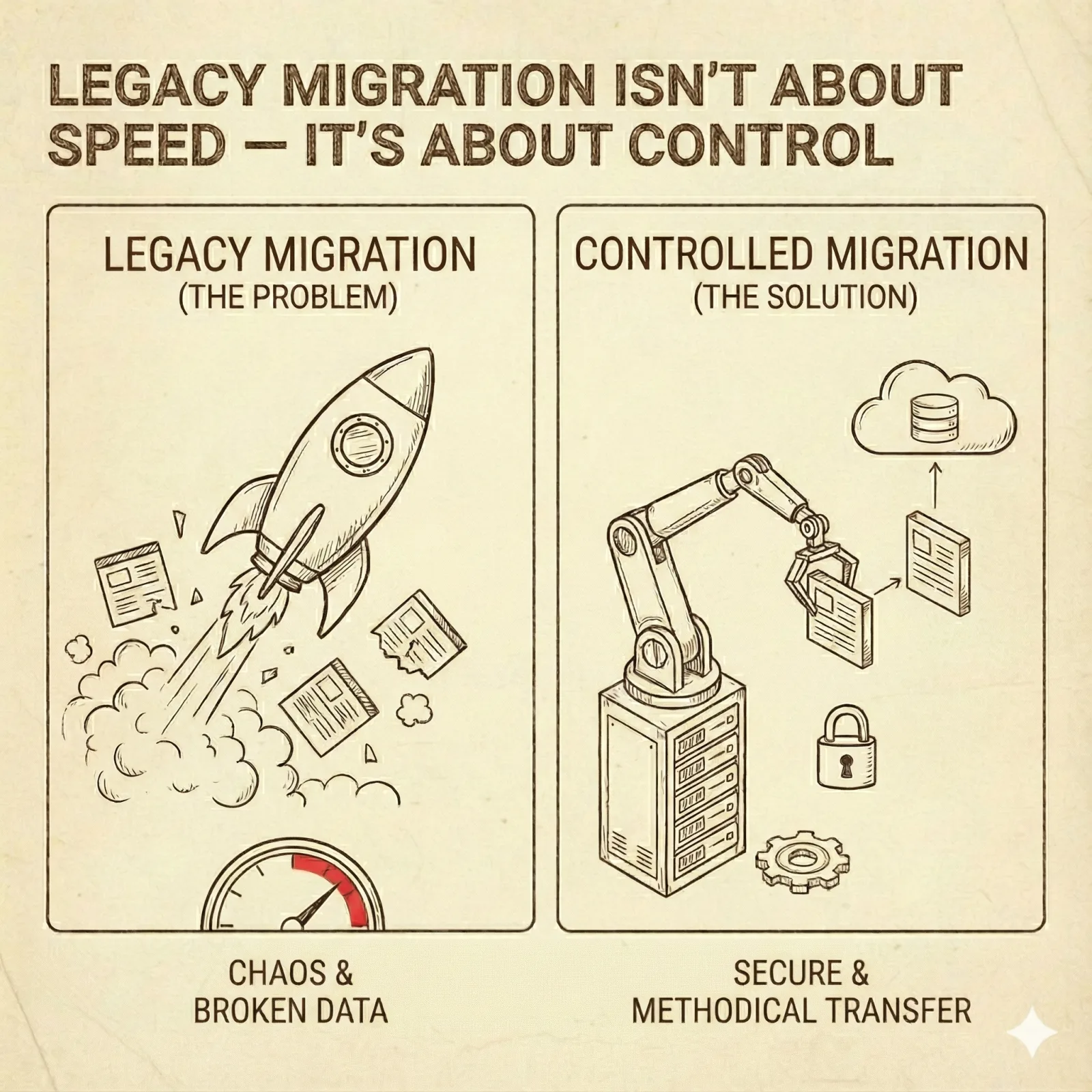
Legacy Migration Isn’t About Speed - It’s About Control
For the last decade, every modernization pitch has sounded the same:
- “We can rebuild your legacy system in 90 days.”
- “Lift-and-shift in weeks, not years.”
- “AI will rewrite your codebase automatically.”
But here’s the truth enterprises already know — and most vendors don’t want to admit:
Legacy migration is not a speed problem.
It’s a control problem.
If speed were all that mattered, enterprises would’ve migrated everything years ago.
The real friction sits somewhere else:
architecture, risk, data, governance, processes, compliance, stability, people, vendors, and history.
Legacy isn’t hard because of the code.
Legacy is hard because of everything wrapped around the code.
Let’s break down the real reasons — and the real future of migration.
1. Legacy survives because it works… until it doesn’t
Legacy systems in banks, asset managers, insurers, and corporates rarely survive due to negligence.
They survive because:
- They encode decades of institutional knowledge
- They’ve been hardened by years of edge cases
- They support revenue-generating flows
- They integrate with dozens of upstream and downstream systems
- They’re stable — even if they’re ugly
When you ask leaders why they haven’t migrated yet, the answer is never:
“We didn’t know how to rewrite it.”
It’s almost always:
“We didn’t trust anyone to not break it.”
Legacy is less about technology, and more about fear of losing control.
2. Migration isn’t a technical rewrite — it’s an architectural realignment
Every legacy system eventually violates the enterprise’s evolving target architecture.
That misalignment shows up as:
- Data duplicated across systems
- Business logic embedded in the wrong layers
- Integrations that no one wants to touch
- Processes stitched together across tools
- Architectural drift that accumulates slowly, then all at once
Modernization isn’t merely turning COBOL into Java, or Oracle stored procedures into microservices.
It’s answering this question:
“How do we bring this system back into alignment with the architecture we want — not the architecture we inherited?”
That’s not speed.
That’s design, governance, and structure.
3. Migration fails when teams focus on velocity instead of boundaries
Every failed migration has the same root cause:
Teams try to go fast before they define the rules.
The result is predictable:
- Architectural inconsistencies
- Siloed rewrites
- Broken integrations
- Missing controls
- Misaligned patterns
- Poor documentation
- Regression defects
- Compromised data integrity
A fast migration without guardrails creates a new legacy system — just written in a modern language.
This is the dirty secret of most “modernization accelerators.”
4. The real enemy: uncontrolled change
Modern enterprises don’t fear slowness.
They fear chaos.
This is why CIOs and CTOs lose sleep over:
- Unreviewed architectural drift
- Hidden changes deep inside critical workflows
- Loss of institutional logic
- Poor test coverage
- Unverifiable compliance
- Lack of audit trails
- Unpredictable deployments
- Vendor-like black boxes
Migration is dangerous when you don’t know — with evidence — what changed, why it changed, and whether it aligns with your enterprise control plane.
This is the core of the problem.
5. AI alone doesn’t solve migration — it accelerates the chaos
AI code generation tools promise speed:
- “Rewrite this codebase.”
- “Generate the new service.”
- “Convert this logic automatically.”
But without architectural constraints and enterprise controls, AI introduces:
❌ inconsistent patterns
❌ incompatible components
❌ mismatched dependencies
❌ governance violations
❌ non-deterministic changes
❌ undocumented gaps
❌ security oversights
AI increases output.
But output without control is risk.
This is why enterprises don’t want fast AI,
They want governed AI.
6. The new model: Controlled migration through AI agent squads
The future of migration isn’t:
- one giant AI assistant
- auto-generated code dumps
- or big-bang rewrites
The future is:
Governed, architecture-aware AI agent squads working inside your target state.
Here’s how migration works when done correctly:
- Architect agent defines the migration pattern
(componentization, boundaries, layering, data flows) - Developer agents rewrite code, component by component
(not a big-bang rewrite) - Testing agents create and maintain regression suites
(confidence you don’t break what works) - Security & risk agents enforce controls
(all changes are audited and evidence-backed) - Documentation agents update architecture, flows, and runbooks
(no knowledge lost) - Deployment agents orchestrate and validate releases
(predictability + traceability)
This isn’t about speed alone —
It’s about bringing control, governance, and architecture into the migration process.
7. Migration becomes continuous, not catastrophic
The old migration playbook was binary:
- live in the legacy system
- plan a multi-year rewrite
- pray
- switch everything at once
That model is dead.
AI-enabled SDLC with agent squads enables:
- incremental modernization
- component-level rewrites
- safe coexistence with legacy
- versioned transformations
- controlled rollouts
- reversible changes
- continuous regression testing
Migration becomes less like a “moon landing”
and more like breathing.
8. The real ROI: You regain power over your architecture
Enterprises don’t want to migrate fast —
they want to migrate intentionally.
What they’re really after is:
- architectural alignment
- reduced technical risk
- controlled evolution
- standardized patterns
- maintainability
- visibility
- ownership
- future-proofing
This is how enterprises escape:
- SaaS lock-in
- legacy constraints
- integration traps
- technology drift
Migration is not about velocity.
It’s about restoring authority over your systems.
Speed is simply a side effect of doing it right.
**Closing:
Legacy dies when control returns to the enterprise — not when someone rewrites code faster.**
The industry worships speed.
Enterprises worship control.
When you combine:
- AI-enabled agent squads
- target architecture alignment
- full governance
- continuous modernization
- controlled change management
…you don’t just migrate faster.
You migrate correctly.
And for enterprises, “correctly” beats “quickly” every single time.
Entrepreneur, technologist and founder. My background combines deep technical roots with real-world operational leadership. I’ve held senior and C-level roles at Goldman Sachs, Merrill Lynch, HSBC, and BTG Pactual, and operated across the world’s key financial centers -New York, São Paulo, Hong Kong, and London. Now focused on advising, investing in, and launching new ventures - particularly where AI, developer productivity, and financial innovation intersect. I bring a builder’s mindset, proven execution across multiple markets, and a strong global network of investors, founders, and enterprise leaders.