 Promenaut
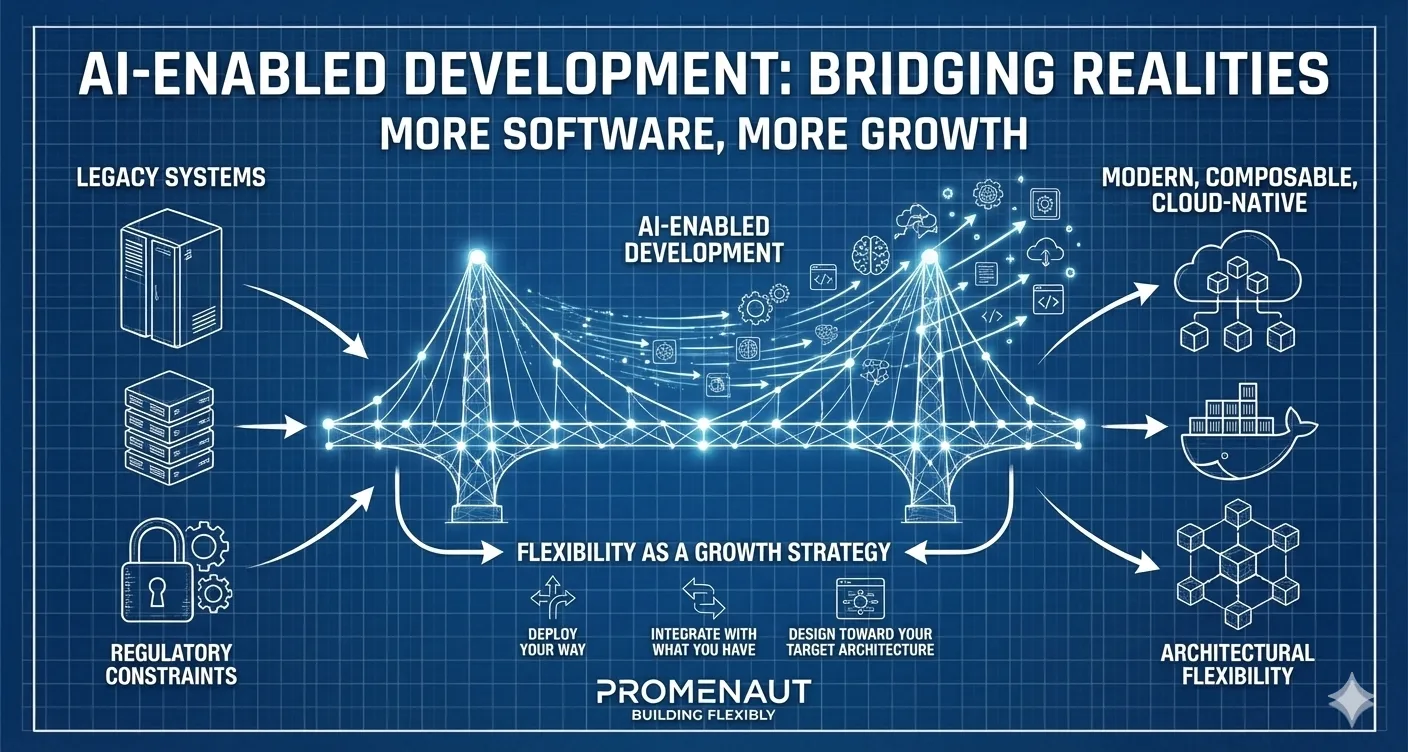
Two architectures, one reality
Every enterprise lives with two architectures:
The one they have. Legacy systems, acquired platforms, hard-won integrations, regulatory constraints.
The one they're building toward. Modern, composable, cloud-native, flexible, future-ready.
The opportunity isn't choosing between them.
It's bridging them - operating in the present while designing for the future.
That's where AI-enabled development changes the game.
AI means more software, not less
There's a common assumption that AI will reduce the amount of software being built. Fewer lines of code. Smaller teams. Simpler systems.
History suggests something more interesting.
This is Jevons' Paradox. When a resource becomes more efficient to use, we don't use less of it - we use more.
Coal-efficient steam engines didn't reduce coal consumption. They exploded it.
AI-efficient development won't reduce software creation. It will multiply it.
More internal tools. More custom workflows. More domain-specific applications. More ambitious systems that were never economically viable before.
The enterprises that thrive will be the ones ready for that growth — building faster, with more people, across more use cases.
That makes architectural flexibility more important than ever.
Flexibility as a growth strategy
If AI only added efficiency, rigid architectures might be fine.
But AI adds volume.
More software means:
- more integration points
- more deployment targets
- more compliance requirements
- more teams building simultaneously
- more systems to govern, maintain, and evolve
The platforms that scale with this reality are the ones that adapt — to what you have, to what you're building toward, and to the volume of software AI will help you create.
Meeting enterprises where they are
Enterprises operate in complex environments. Regulatory requirements. Existing technology investments. Data residency constraints. Unique business processes.
AI-enabled development should work within those realities - not ask you to abandon them.
That means AI that operates in your current state while helping you build toward your target state.
It's a design philosophy built for how enterprises actually work.
What architectural flexibility looks like in practice
Deploy your way.
On-premises. Cloud. Hybrid. Multi-cloud. Air-gapped environments. Regulated infrastructure.
AI-enabled development adapts to where your software must run - not where a vendor prefers it to run.
Integrate with what you have.
Existing CI/CD pipelines. Enterprise data platforms. Identity and access management. Monitoring and observability. Security tooling.
Your current investments become foundations, not obstacles.
Design toward your target architecture.
This is the key unlock:
You can operate in your current state while building for your future state.
AI can generate code, components, and workflows that conform to your target architecture - even if that architecture doesn't fully exist yet.
You're not just building software. You're building toward a destination.
Choose your AI providers.
No single model fits every use case. No single vendor should own your AI strategy.
Support for multiple AI providers - including proprietary models - keeps you in control of cost, capability, and compliance.
A composable approach for diverse enterprises
No two enterprises are alike.
Industry regulations. Technology stacks. Data residency requirements. Organizational structures. Business processes refined over decades.
Enterprise-grade AI development embraces that diversity with a composable, extensible architecture:
- Configurable components — not monolithic features
- Reusable patterns — aligned to your standards
- Templated logic — capturing institutional knowledge
- Customizable workflows — matching your approval processes
- Scalable deployment — from departmental pilots to enterprise-wide rollouts
This isn't flexibility for its own sake.
It's about building software that fits - technically, operationally, and regulatorily.
And it's about being ready for a world with far more software than today.
The impact
Work within your constraints.
Regulatory. Technical. Operational. Political.
AI becomes an accelerant that respects your reality.
Build toward the future while maintaining the present.
Your current architecture isn't a blocker. It's a starting point.
Every component AI helps you build can be designed for where you're going - even as it runs where you are.
Modernize incrementally.
Legacy modernization doesn't have to be existential.
When AI adapts to your architecture, modernization becomes a continuous process - not a leap of faith.
Scale with confidence.
AI won't slow down. The software it helps create will only increase.
Architectural flexibility is how you absorb that growth - and turn it into advantage.
The bottom line
Enterprise AI is about building software that fits your architecture - today and tomorrow.
The platforms that succeed in the enterprise will be the ones that disappear into your stack - and help you build toward the stack you actually want.
In a world where AI multiplies software creation, the enterprises that win won't just be the ones who build fastest.
They'll be the ones who build flexibly.
At Promenaut, we believe AI should work within your constraints, not create new ones. Our platform adapts to your architecture - cloud, on-premises, or hybrid - so you can build toward your target state while operating your current one.
Entrepreneur, technologist and founder. My background combines deep technical roots with real-world operational leadership. I’ve held senior and C-level roles at Goldman Sachs, Merrill Lynch, HSBC, and BTG Pactual, and operated across the world’s key financial centers -New York, São Paulo, Hong Kong, and London. Now focused on advising, investing in, and launching new ventures - particularly where AI, developer productivity, and financial innovation intersect. I bring a builder’s mindset, proven execution across multiple markets, and a strong global network of investors, founders, and enterprise leaders.