 Promenaut
The wrong question about AI
As we close out the year, the AI conversation is still framed around the wrong question:
"Will AI replace developers?"
It's the wrong question because it assumes software development is a zero-sum game - that productivity gains must mean fewer builders.
History tells us the opposite.
Every major leap in tooling - from compilers to cloud to open-source - didn't reduce the need for engineers. It expanded what could be built.
AI will do the same. But the shift coming in 2026 is bigger than productivity.
AI will fundamentally expand who gets to participate in building software.
From coding to building: a broader software lifecycle
For decades, software creation has been gated by one constraint: the ability to write code.
That constraint is disappearing.
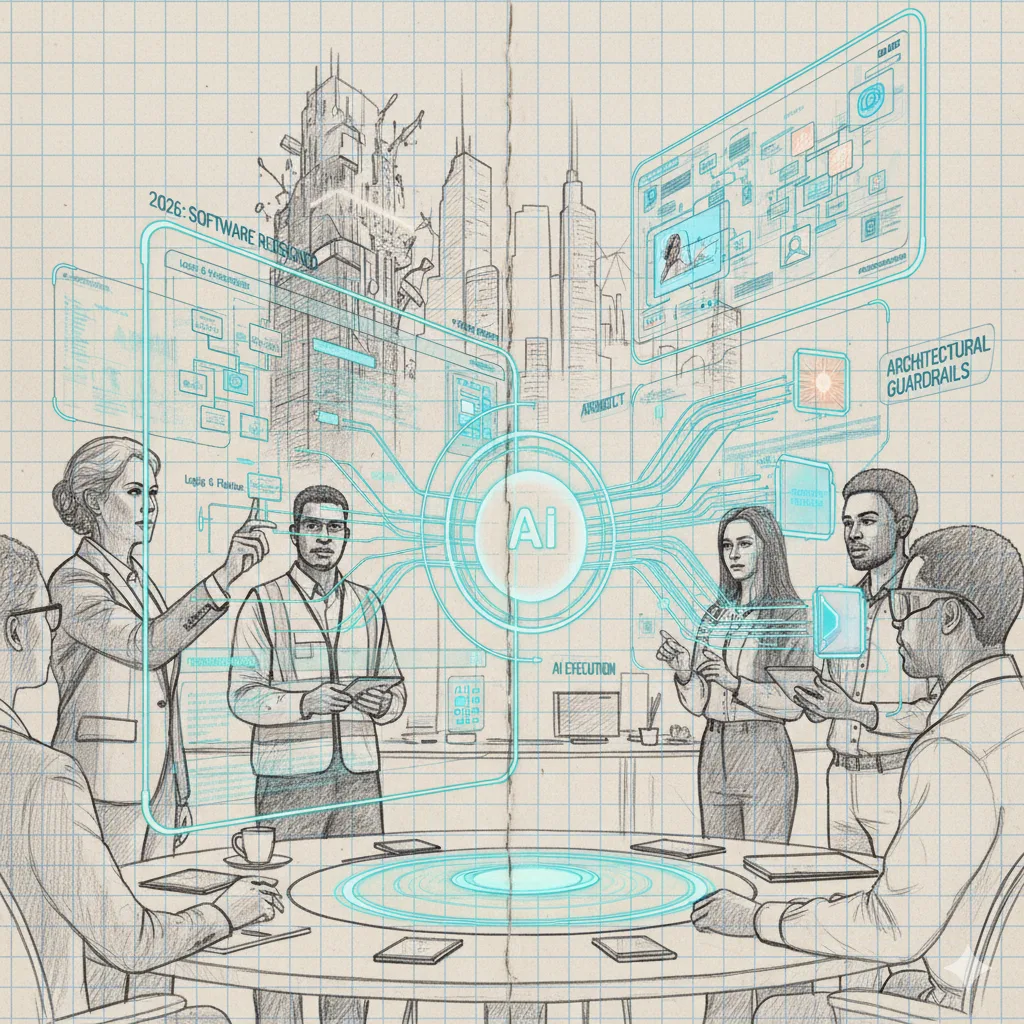
In an AI-enabled software development lifecycle, intent matters more than syntax.
- Business leaders describe outcomes
- Domain experts shape logic and flows
- Product teams iterate in real time
- Architects define constraints and patterns
- AI executes large portions of implementation
This doesn't remove rigor. It redistributes it.
The SDLC becomes a collaborative system - not a handoff chain.
Non-developers enter the SDLC - safely
In 2026, non-developers won't be "coding."
They'll be:
- defining workflows — describing what the system should do in business terms
- shaping rules — a compliance officer specifying regulations, a supply chain manager setting thresholds
- validating scenarios — testing edge cases against real-world expertise
- refining requirements — surfacing conflicts and gaps that only domain experts can see
- testing outcomes — verifying that what was built matches what was intended
- evolving systems over time — participating in maintenance, not just initial delivery
AI translates that intent into software - under architectural guardrails, governance, and human review.
The domain knowledge that used to get lost in translation between business and engineering?
It stays intact.
This is the critical difference between chaos and scale.
Non-developers aren't replacing engineers. They're joining the lifecycle.
And that changes everything.
The engineer's role doesn't shrink - it evolves
The idea that AI reduces the need for engineers misunderstands what engineers actually do.
In an AI-enabled SDLC, engineers become:
- architects
- system designers
- platform builders
- constraint definers
- reviewers of complex logic
- owners of quality and correctness
- innovators, not implementers
As execution becomes cheaper, ambition increases.
Teams don't say: "We need fewer engineers."
They say: "We can finally build the things we couldn't before."
Legacy modernization finally becomes possible
Perhaps the most under-appreciated impact of AI is what it unlocks:
Real legacy modernization - at scale.
For decades, enterprises have lived with systems they couldn't change:
- too complex
- too risky
- too intertwined
- too expensive to rewrite
AI changes this by:
- analyzing legacy systems continuously
- mapping dependencies
- extracting logic
- rewriting components incrementally
- maintaining regression safety
- documenting everything
This isn't about speed alone. It's about control.
For the first time, enterprises can modernize without betting the business.
More capability leads to more software - not less
Here's the paradox many miss:
When building becomes easier, demand explodes.
- More internal tools
- More differentiated systems
- More personalized workflows
- More domain-specific software
- More experimentation
As barriers fall, ambition rises.
AI doesn't reduce software creation. It multiplies it.
And that means:
- more builders
- more engineers
- more architects
- more innovation
2026: the year software becomes a team sport
In the year ahead, the most successful organizations won't ask: "How do we use AI to code faster?"
They'll ask: "How do we redesign software creation itself?"
They'll build environments where:
- non-developers can contribute safely
- engineers focus on architecture and innovation
- AI handles execution and scale
- governance is embedded, not bolted on
- legacy becomes a source of progress, not drag
That's not a prediction. It's already starting.
2026 is the year it becomes undeniable.
Finally
AI won't shrink the world of software. It will expand it.
More people will build. More engineers will be needed. More complex systems will exist. And the organizations that embrace this shift early will redefine what's possible.
The future of software isn't fewer builders. It's better builders - working together with AI.
Entrepreneur, technologist and founder. My background combines deep technical roots with real-world operational leadership. I’ve held senior and C-level roles at Goldman Sachs, Merrill Lynch, HSBC, and BTG Pactual, and operated across the world’s key financial centers -New York, São Paulo, Hong Kong, and London. Now focused on advising, investing in, and launching new ventures - particularly where AI, developer productivity, and financial innovation intersect. I bring a builder’s mindset, proven execution across multiple markets, and a strong global network of investors, founders, and enterprise leaders.