 Promenaut
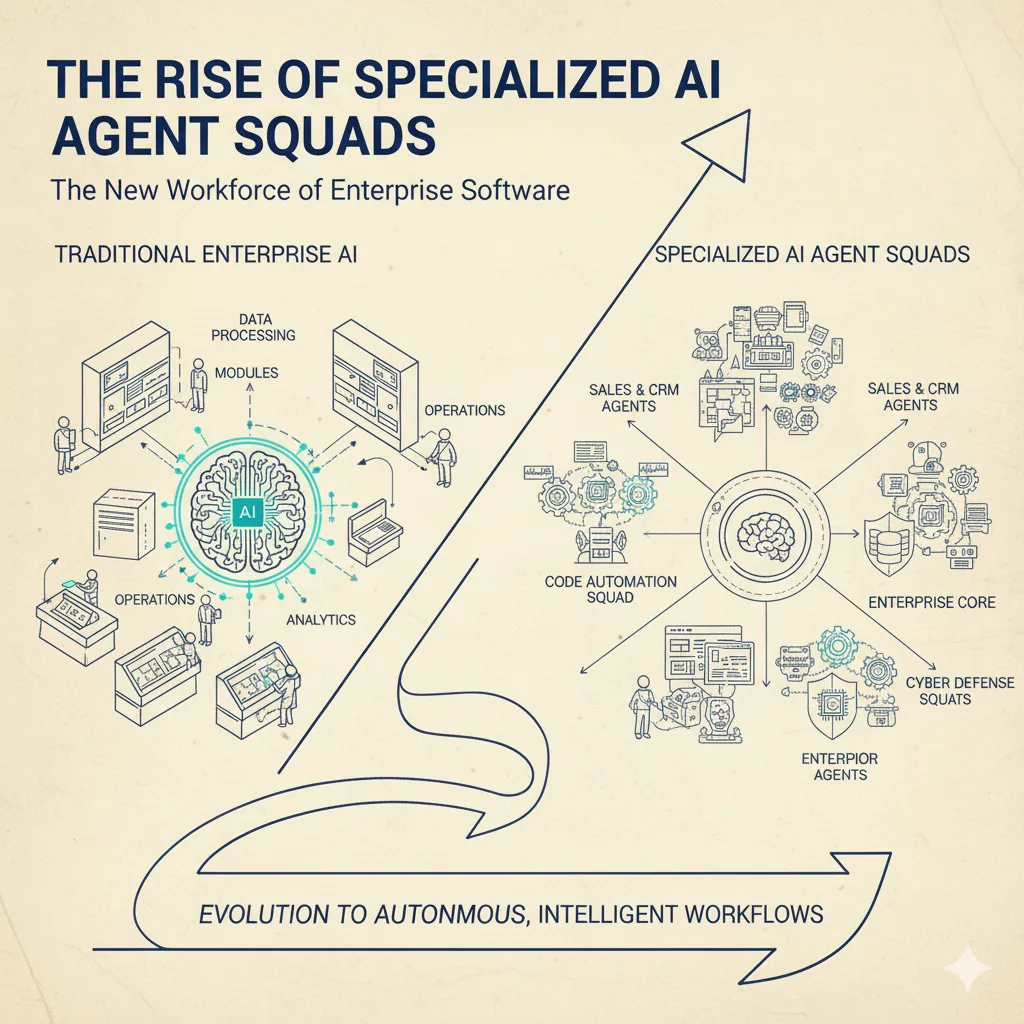
Intro: The era of the “one big AI agent” is already dead
Most of the AI world is still obsessed with the wrong model:
“What if we had one super-agent that does everything?”
Cute idea.
Terrible reality.
Real enterprise software isn’t built by one person —
and it won’t be built by one agent either.
Software is built by teams:
- developers
- architects
- QA testers
- security reviewers
- analysts
- PMs
- operations
So the future isn’t a giant omnipotent AI.
The future is specialized AI agent squads that mirror — and massively accelerate — how real SDLC teams work.
This is the beginning of the AI workforce.
1. Why single AI agents fail inside real enterprises
One AI agent writing code in a demo is cute.
One AI agent inside a Tier-1 bank? A liability.
Real enterprise software requires:
- strict architectural patterns
- layering rules
- security boundaries
- separation of duties
- approvals
- traceability
- auditability
- predictable behavior
- cross-team integration
A single agent trying to do everything:
❌ Can’t enforce architecture
❌ Can’t guarantee compliance
❌ Can’t self-review its own work
❌ Can’t supply audit trails
❌ Can’t defend decisions
❌ Can’t be trusted with production pathways
The enterprise doesn’t want autonomy —
It wants control, predictability, and speed.
A single agent gives you zero of those.
2. The breakthrough: treat AI not as a tool, but as a team
Here’s the shift:
AI isn't a tool used by developers.
AI offers an entire digital workforce.
But in roles.
In specializations.
In teams.
Not as a monolithic black box that magically does everything.
Just as humans specialize, AI must specialize too.
Enter:
AI architect agents
AI developer agents
AI tester agents
AI security agents
AI documentation agents
AI BA/requirements agents
AI release/operations agents
Each with:
- a purpose
- scope
- guardrails
- permissions
- workflows
- logs
- governance touch points
This isn’t “an agent.”
This is a digital organization.
3. What an AI agent squad actually looks like
Let’s break down the core squad roles.
1. Developer Agent
Executes tasks like:
- implementing new features
- refactoring
- fixing bugs
- generating tests
- evolving components
But always within architecture constraints — enforced by the next agent.
2. Architect Agent
The most important agent in the enterprise.
Responsible for:
- enforcing target architecture
- checking layering boundaries
- selecting patterns
- reviewing design proposals
- ensuring security & compliance constraints
- validating component reuse
This is the agent most AI-tool competitors don’t have —
which is why their output doesn’t scale in enterprise environments.
3. Tester Agent
Generates and maintains:
- unit tests
- integration tests
- scenario tests
- regression coverage
Also triggers automated test suites whenever code changes.
A must-have for trust and reliability.
4. Security & Risk Agent
The guardian of regulated industries.
Handles:
- threat models
- data-flow validation
- policy compliance
- segregation of duties
- audit evidence
- approval checkpoints
If AI is going to ship software into a bank or insurer,
this agent is mandatory.
5. Documentation Agent
A role most teams forget — but critical.
Maintains:
- architecture docs
- sequence diagrams
- API spec updates
- business requirements
- operational runbooks
And keeps everything aligned as the system evolves.
6. Business / Requirements Agent
The agent that interfaces with product owners and SMEs.
It helps:
- refine requirements
- validate flows
- ask clarifying questions
- translate business logic into component-level work
This is where non-developers get pulled into the new SDLC.
7. Operations / Deployment Agent
Owns the last mile.
Handles:
- environment provisioning
- deployment pipelines
- config changes
- runtime monitoring summaries
Under full governance and approvals.
4. Why specialization beats “one big agent” every time
The AI industry is repeating an old mistake:
Trying to build a single agent that knows every role, every rule, every workflow.
This is like hiring one person to be:
- CTO
- developer
- QA
- CISO
- architect
- PM
- DBA
- DevOps
No human team is structured like that.
Why would an AI team be?
Specialization gives you:
✔ Traceability
Each role logs its decisions.
✔ Governance
Each role has defined permissions.
✔ Predictability
Each role produces consistent artifacts.
✔ Separation of duties
A must for regulated markets.
✔ Reviewability
Humans can approve or block at each step.
✔ Replaceability
Swap out agents without breaking the system.
✔ Quality
Each role becomes world-class at its domain.
Speed comes from parallelism, not monoliths.
5. How AI agent squads actually work together (real enterprise flow)
A real end-to-end workflow looks like this:
PM/BA agent refines the requirement
→ Identifies edge cases
→ Proposes flow diagrams
Architect agent designs the solution
→ Applies patterns
→ Selects components
→ Ensures alignment to target architecture
Developer agents implement
→ Generate code
→ Write tests
→ Integrate with components
Tester agent validates
→ Unit + integration + regression
→ Coverage reporting
Security agent verifies
→ Data boundaries
→ Threat models
→ Compliance evidence
Documentation agent updates everything
→ Architecture
→ Sequence diagrams
→ API specs
Ops agent prepares deployment
→ Build pipeline
→ Environment config
→ Rollout
Humans step in at governance checkpoints —
but the heavy lifting is done by the digital workforce.
This is the AI-enabled SDLC in action.
**6. The biggest misconception: “AI replaces developers.”
No — AI replaces busywork. Humans level up.**
Here’s the real shift:
The role of the human developer becomes:
- system owner
- constraint designer
- reviewer
- quality gatekeeper
- architecture decision-maker
- digital workforce manager
The AI agents become:
- implementers
- translators
- testers
- maintainers
- documenters
The work humans should be doing becomes their focus.
The rest is delegated to specialized AI.
This is not automation.
This is organizational evolution.
7. Why this model will dominate the enterprise
Enterprises need:
- governance
- auditability
- traceability
- predictability
- architecture compliance
- ability to integrate deeply
- ability to evolve rapidly
Single agents can’t do that.
Even “general AI developers” can’t do that.
But squads of specialized agents can.
This is the first AI model that:
✔ works in regulated industries
✔ scales across hundreds of systems
✔ aligns to enterprise target architectures
✔ brings non-developers into the SDLC
✔ enables controlled modernization
This is the “AI workforce” —
not a gimmick, but the next operating model for enterprise technology.
**8. The impact is enormous:
The SDLC doesn’t just get faster —
it becomes fundamentally different.**
With specialized AI squads:
- Architecture becomes enforceable
- Legacy becomes replaceable
- SaaS becomes optional
- Migration becomes continuous
- Risk becomes embedded
- Documentation keeps pace
- Compliance becomes automated
This isn’t acceleration.
This is reinvention.
**Closing:
The future of enterprise software isn’t built by tools.
It’s built by teams — digital teams.**
The era of the single AI assistant is ending.
The era of the AI workforce is beginning.
The companies that embrace specialized AI agent squads will:
- build faster
- migrate faster
- govern better
- modernize continuously
- and finally break free from SaaS and legacy constraints
The companies that don’t?
They’ll still be waiting for their “AI assistant” to finish scaffolding a demo app.
Entrepreneur, technologist and founder. My background combines deep technical roots with real-world operational leadership. I’ve held senior and C-level roles at Goldman Sachs, Merrill Lynch, HSBC, and BTG Pactual, and operated across the world’s key financial centers -New York, São Paulo, Hong Kong, and London. Now focused on advising, investing in, and launching new ventures - particularly where AI, developer productivity, and financial innovation intersect. I bring a builder’s mindset, proven execution across multiple markets, and a strong global network of investors, founders, and enterprise leaders.