 Promenaut
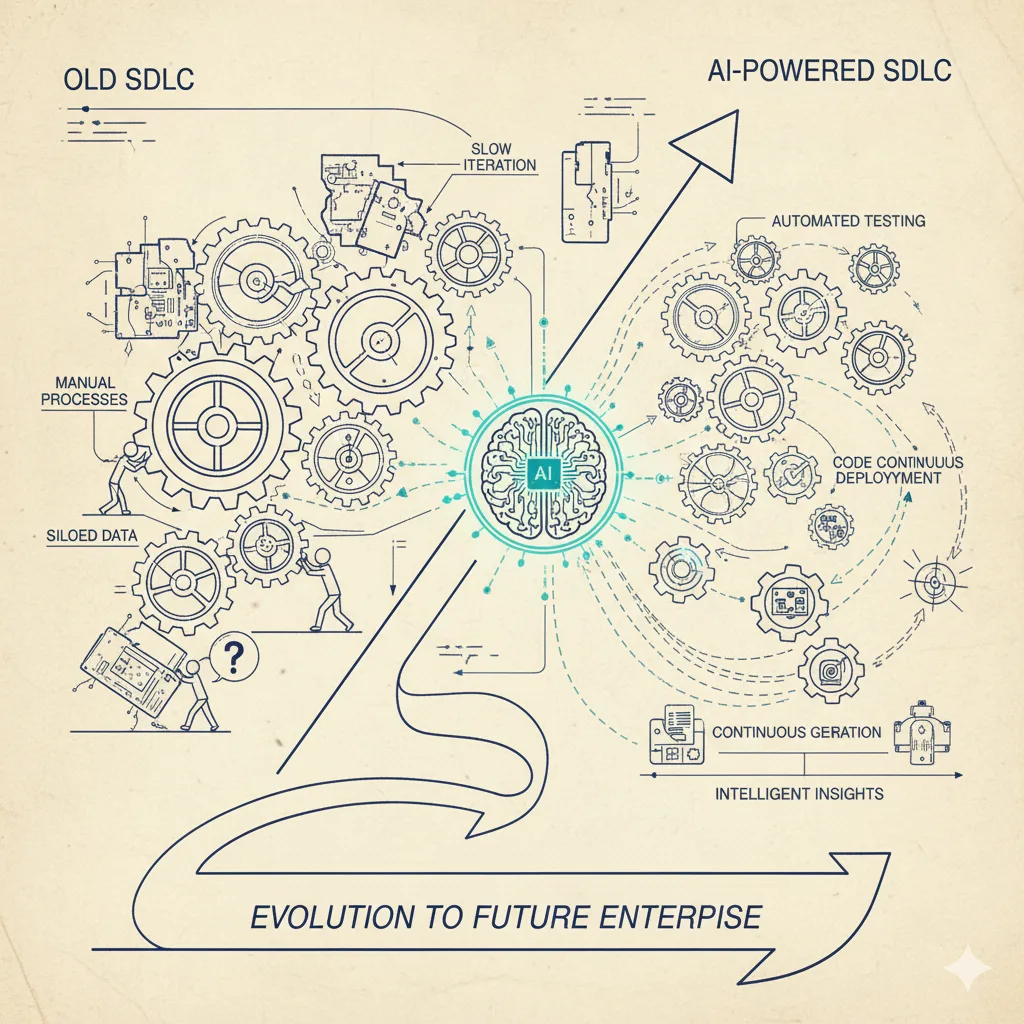
Opening
For the last decade, most enterprises have been asking a version of the same question:
“How do we build software faster?”
Low-code, no-code, offshore, agile, DevOps, platforms, accelerators, centers of excellence - we’ve tried almost everything. And yet the core experience inside many banks, asset managers, insurers, and large corporates hasn’t really changed:
- Multiple teams duplicating work in different stacks
- Legacy systems nobody wants to touch, but everybody depends on
- “Modernization programs” that take years
- A backlog that grows faster than the organization can deliver
Now AI has arrived, and a new question is emerging:
“What does a truly AI-enabled SDLC look like - not just a few copilots, but an end-to-end way of building and evolving software?”
This post lays out that model.
The problem with today’s “AI for developers”
Most AI initiatives in software delivery today look like this:
- A copilot in the IDE that speeds up typing
- A chatbot that explains code or documentation
- A PoC agent that can scaffold a small app on a demo stack
These are useful - but they don’t add up to a new SDLC. In a regulated enterprise, the questions are different:
- How do I control what AI can do?
- How do I align AI outputs with my target architecture?
- How do I govern AI across security, risk, and compliance?
- How do I bring non-developers into this new way of building?
A handful of AI tools sprinkled into an unchanged SDLC is like adding rockets to a 19th-century train. You’ll go faster… until the tracks run out.
From SDLC to AI-Enabled Digital Workforce
A genuinely AI-enabled SDLC isn’t about tools; it’s about workforces.
Instead of asking:
“How can a single developer use AI to write more code?”
We ask:
“What would it look like if an entire squad of AI agents worked together with humans to design, build, test, secure, deploy, and maintain an application under enterprise controls?”
This workforce includes:
- Prometheus-style developer agents: implement features, refactor, write tests
- Architect agents: enforce target architecture, patterns, and guardrails
- Security & risk agents: check controls, data flows, policies
- Testing agents: generate and maintain test suites, run regression checks
- Documentation agents: keep technical and business docs aligned with reality
- Business-facing agents: work directly with product owners and SMEs on requirements
Humans don’t disappear. They move up a level: designing intent, reviewing plans, validating decisions, and steering where the digital workforce focuses.
The 6 characteristics of an AI-enabled SDLC
In enterprises, an AI-enabled SDLC must have six non-negotiable properties:
- Target-architecture aligned
AI agents can’t just “pick a stack.” They must build into your reference architectures, patterns, and technology standards - not theirs. - Governed and auditable
Every change, decision, and artifact needs traceability:- Who approved this change?
- Which agent made it?
- Which controls were checked?
- What evidence exists for sign-off?
- Multi-role agent squads
Not one giant “do everything” agent, but specialized roles:- Developers, testers, architects, security, PM, BA
Each with constraints and responsibilities - like a real team.
- Developers, testers, architects, security, PM, BA
- Human-in-the-loop by design
Checkpoints are built into the process:- Architecture approvals
- Security sign-offs
- Business acceptance
This isn’t a “let AI ship to prod” model - it’s “let AI do the work, and let humans govern the outcomes.”
- Composable components, not fragile scripts
Outputs shouldn’t be one-off code dumps. The system should build from reusable components that can be:- Versioned
- Governed
- Reused across teams and applications
- Built for legacy coexistence and migration
The real world is messy. An AI-enabled SDLC must:- Integrate with existing systems
- Wrap legacy where needed
- Help you migrate off old platforms incrementally
What changes for CIOs and heads of engineering?
When you move to an AI-enabled SDLC:
- Roadmaps change
You don’t just ask, “What features can this team ship in Q4?”
You ask, “What can this digital workforce do if we point it at these 3 systems for 90 days?” - Team shape changes
You still have engineers - but fewer doing low-level plumbing, and more:- Designing architectures
- Governing platforms
- Curating components
- Shaping how AI workforces operate
- Backlogs change
You can finally tackle problems that used to be “impossible given our resourcing”:- Rewriting a critical but ugly legacy process
- Migrating off a vendor that’s become a constraint
- Standardizing patterns across regions or business units
What changes for non-developers?
This is where the model gets powerful.
In an AI-enabled SDLC, non-developers are no longer throwing requirements over the wall. They collaborate with the digital workforce directly:
- Product owners define intent in structured ways
- Business SMEs iterate on flows, rules, constraints
- Operations teams validate scenarios through agents that “speak their language”
Behind the scenes, the AI workforce translates that intent into architecture, code, tests, and documentation - subject to the guardrails you’ve defined.
This is how you get “build without coding, launch like an engineer, govern like an enterprise” in practice.
What enterprises should do now
If you’re a CIO, CTO, or head of change, the move to an AI-enabled SDLC starts with three steps:
- Define your target architecture and guardrails
Decide what “good” looks like:- Preferred stacks
- Integration patterns
- Security and data boundaries
- Identify 1–3 critical journeys or systems
Not toy projects. Real, painful areas where:- There’s clear value in modernization
- Stakeholders are aligned
- Legacy or SaaS is limiting your options
- Pilot with an AI workforce, not a single tool
Think in terms of:- A squad of specialized agents
- Clear checkpoints
- Audit trail and governance
- Measurable outcomes (speed, quality, risk, flexibility)
Closing
The AI moment in software development isn’t about getting developers to type code faster.
It’s about rethinking the SDLC around digital workforces: specialized, governed, architecture-aware AI squads that work alongside humans.
The enterprises that make this shift early won’t just build faster.
They’ll build on their own terms, aligned with their target architectures, and free from the limitations of yesterday’s tools and vendors.
Over the next few posts, we’ll go deeper into why Enterprise SaaS has quietly become the new legacy, and how specialized AI agent squads change what’s possible inside regulated environments.
Entrepreneur, technologist and founder. My background combines deep technical roots with real-world operational leadership. I’ve held senior and C-level roles at Goldman Sachs, Merrill Lynch, HSBC, and BTG Pactual, and operated across the world’s key financial centers -New York, São Paulo, Hong Kong, and London. Now focused on advising, investing in, and launching new ventures - particularly where AI, developer productivity, and financial innovation intersect. I bring a builder’s mindset, proven execution across multiple markets, and a strong global network of investors, founders, and enterprise leaders.